From fixed cards to software-defined AST

Software-defined antimicrobial susceptibility testing

Combi-DX automates antimicrobial susceptibility testing (AST), one of the highest-volume tests in clinical microbiology, on a microfluidic cartridge reconfigured by software. It replaces fixed test cards with software-defined testing, with a lower cost per case as the target.

In development · Not yet CE-IVD marked · Open to partner laboratories

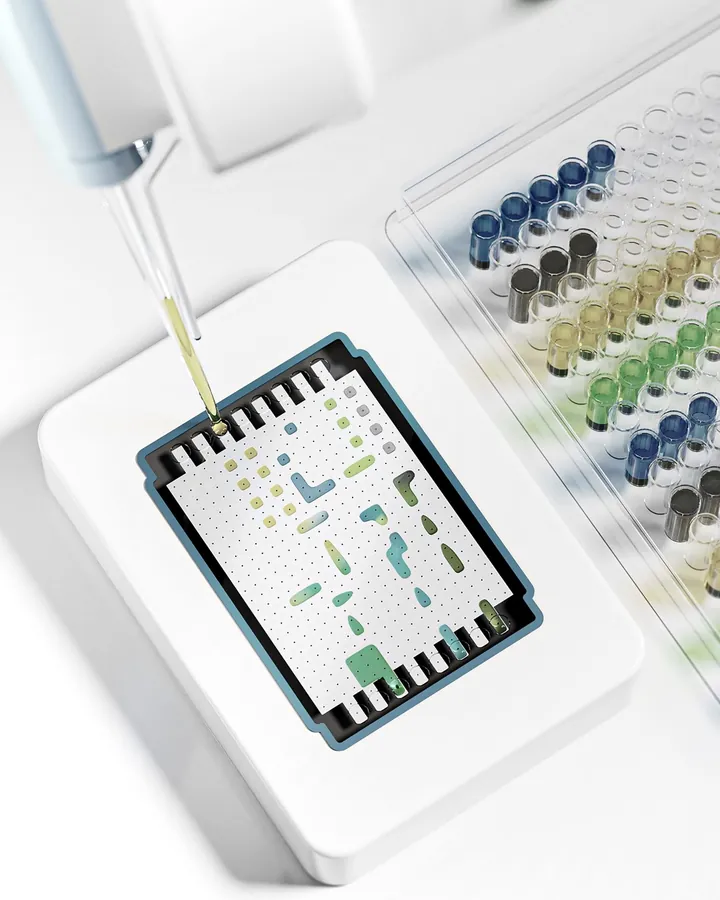
Illustration of a digital microfluidic cartridge on its instrument, with a pipette loading a sample and droplets on the electrode array
Concept illustration

Flat tariffs, rising testing costs

AST tells clinicians which antimicrobials will work against the microorganism isolated from a patient. It is routine work at scale, and its economics are unforgiving.

In Switzerland, for example, a urine culture is reimbursed under a flat tariff that includes identification and AST, whatever the number of isolates or successive tests, and laboratory tariffs are under steady pressure. Card-based analysers consume one fixed, single-use card per isolate and per panel: every card, from the first, erodes the laboratory's margin. When the first panel does not answer the clinical question, the laboratory opens another card and pays for another consumable, while reimbursement does not move.

Laboratories buy AST on full cost per completed case.

Our approach

Digital microfluidics turns the cartridge into a programmable test surface. Flexibility becomes margin.

01

Programmable cartridge

Droplets of sample and reagents move across an array of electrodes. Antibiotic panels and dilution series are defined in software, and successive protocols run on the same cartridge, within its capacity, without a new card each time.

02

Reference method, true MIC

The instrument performs broth microdilution, the reference method of EUCAST and CLSI described in ISO 20776-1, and reports a true minimum inhibitory concentration (MIC) for each antibiotic, the result that guides targeted therapy.

03

Sized to the laboratory

A compact, modular instrument, designed to match the laboratory's peak workload. The target is a lower full cost per completed case and a better use of the fixed reimbursement.

Adaptive continuation, towards precision medicine for each patient and each infection. When a first result calls for further testing, the run continues with additional antibiotics and dilutions, each step approved by an authorised healthcare professional, instead of restarting the next day with a new card. This matters most in multidrug-resistant infections, where tests run in series.

One platform, three susceptibility tests

The same programmable platform serves antibiotics, phages and antifungals, a step towards precision medicine in infectious diseases.

Antibiotics · AST

Antimicrobial susceptibility testing

Broth microdilution and MIC for bacteria isolated in routine culture, the first application of the platform.

First validation series against the reference method completed with a Swiss clinical laboratory.

Phages · PST

Phage susceptibility testing

Which bacteriophages act against a patient's bacterial strain, for phage therapy research.

Research protocol under way with CHUV, Lausanne University Hospital, home to a phage therapy centre.

Antifungals · AfST

Antifungal susceptibility testing

Susceptibility of fungal isolates to antifungal agents, on the same platform.

Collaboration under way with the University of Neuchâtel.

Synergy and antagonism between antimicrobials, relevant to multidrug-resistant infections, are a further research application of the platform. Also under way: protocol automation with HE-Arc Engineering. Combi-DX is an implementation partner of ORION, the Innosuisse Flagship led by HE-Arc on AI-driven personalised cancer treatment.

How it works

Three notions explain the Combi-DX platform.

Digital microfluidics (DMF)
Droplets sit on an array of electrodes covered by a thin insulating, water-repellent layer. Switching electrodes on and off changes how the surface wets, which moves, merges, splits and mixes the droplets. This principle is called electrowetting-on-dielectric (EWOD). The droplet path is a program, with no pumps or valves.
Broth microdilution
Microorganisms from a cultured isolate are exposed to a series of two-fold dilutions of each antimicrobial in liquid growth medium, then incubated. Growth, or its absence, is read at each concentration.
Minimum inhibitory concentration (MIC)
The lowest antimicrobial concentration that prevents visible growth. Compared with clinical breakpoints, such as those published by EUCAST in Europe and CLSI in the United States, the MIC classifies the isolate as susceptible, susceptible at increased exposure, or resistant.

Development stage

  1. Now

    Development and validation

    The cartridge, the instrument and the protocols are being developed and validated with Swiss clinical and academic partners: a Swiss clinical laboratory, CHUV, the University of Neuchâtel and HE-Arc.

  2. Next

    Research use

    Research-use systems in partner laboratories: antibiotics, phages and antifungals first, then dedicated clinical workflows.

  3. Target

    CE-IVD marking

    Routine AST and antifungal testing on cultured isolates under the EU In Vitro Diagnostic Regulation (IVDR), with a US FDA pathway to follow.

Work with us

We are open to discussing your needs now, while the platform is in development.

Laboratories

Partner laboratories

Clinical microbiology laboratories can take part in research-use evaluation and pilot studies of AST, PST or AfST on the Combi-DX platform, and help shape a test built around their workload.

Become a partner laboratory
Industry and research

R&D services

Feasibility studies, assay miniaturisation and custom development in digital microfluidics and microfluidics, for pharma, biotech, agri-science and academic teams.

See R&D services
Investors

Meet the team

Investors interested in Combi-DX can request a meeting with the CEO, in Neuchâtel or online.

Request a meeting

Company

Combi-DX SA is a Swiss medical technology company based in Neuchâtel. It is an independent company, incorporated on 11 June 2026, which is acquiring the digital microfluidics technology of Preciflex SA and builds on Preciflex's know-how in digital microfluidics and electrowetting. Its focus is in vitro diagnostics against antimicrobial resistance.

Legal name
Combi-DX SA (Combi-DX AG, Combi-DX Inc.)
Incorporated
11 June 2026, Neuchâtel, Switzerland
Registered office
Rue de Prébarreau 17, 2000 Neuchâtel
Company number
UID CHE-257.632.374

Team

Gregory Dourde

CEO and Chairman

Engineer from École des Ponts ParisTech, MBA from Collège des Ingénieurs. CEO of Preciflex SA and originator of the Combi-DX platform, with 25 years leading industrial and technology companies in Switzerland.

LinkedIn profile

Antony Croxatto, PhD, FAMH

Chief Scientific Advisor

Director of Microbiology at ADMed. Formerly head of serology and co-head of bacteriology, mycology and parasitology at CHUV, Lausanne University Hospital. PhD in microbiology and molecular biology, Umeå University.

LinkedIn profile

Daniel Nesta

CFO

Twenty years in finance leadership, including CFO of Geosatis and of Jean Singer & Cie, and fourteen years at Glenmark Pharmaceuticals as Head of Finance.

LinkedIn profile

Frequently asked questions

What does Combi-DX do?

Combi-DX SA is a Swiss medical technology company based in Neuchâtel. It automates antimicrobial susceptibility testing on a software-defined digital microfluidic cartridge, for antibiotics (AST), phages (PST) and antifungals (AfST), and offers R&D services in digital microfluidics and microfluidics.

What is software-defined AST?

Software-defined AST is antimicrobial susceptibility testing in which the antibiotic panel and the dilution series are set by software on a programmable cartridge. Successive protocols can run on the same cartridge, within its capacity, whereas card-based analysers need a new pre-filled card for each isolate and panel.

Why does the cost of AST matter to laboratories?

In Switzerland, for example, a urine culture is reimbursed under a flat tariff that includes identification and AST, whatever the number of isolates or successive tests. With card-based analysers, every card is a cost the flat tariff has to absorb. Laboratories therefore judge AST on its full cost per completed case.

Which method does the Combi-DX platform use?

Broth microdilution on cultured isolates, the reference method of EUCAST and CLSI described in ISO 20776-1. The result is a true minimum inhibitory concentration (MIC) for each antimicrobial tested.

Which susceptibility tests can the platform run?

Three, on the same platform: antimicrobial susceptibility testing of bacteria (AST), validated against the reference method in a first series with a Swiss clinical laboratory; phage susceptibility testing (PST), in research use with CHUV, Lausanne University Hospital; and antifungal susceptibility testing (AfST), with the University of Neuchâtel.

Who does Combi-DX work with?

Combi-DX works with Swiss clinical and academic partners: phage susceptibility testing with CHUV, Lausanne University Hospital; antifungal susceptibility testing with the University of Neuchâtel; and protocol automation with HE-Arc Engineering. Combi-DX is an implementation partner of ORION, the Innosuisse Flagship led by HE-Arc on AI-driven personalised cancer treatment.

Can we work with Combi-DX today?

Yes. The Combi-DX platform is in development and not yet CE-IVD marked, so it cannot be used for clinical diagnosis today. We are open now to evaluation and pilot studies in research use with partner laboratories, to research collaborations, and to R&D projects in digital microfluidics.

Does Combi-DX offer R&D services?

Yes. Combi-DX offers feasibility studies, assay transfer and miniaturisation, and custom cartridge and protocol development in digital microfluidics and microfluidics. Typical fields are pharmaceutical and biotech laboratories (lab-on-a-chip assays), agri-science (for example soil microbiome studies) and academic research.

Who is behind Combi-DX?

Combi-DX is an independent company, incorporated in Neuchâtel, Switzerland, on 11 June 2026, which is acquiring the digital microfluidics technology of Preciflex SA. Gregory Dourde is CEO and Chairman, Antony Croxatto, PhD, FAMH, is Chief Scientific Advisor, and Daniel Nesta is CFO.

How can I contact Combi-DX?

By email at gregory@combi-dx.com. Laboratories, industry and research teams, and investors are welcome to get in touch.

Contact

Tell us about your laboratory, your project or your question.

Combi-DX SA
Rue de Prébarreau 17
2000 Neuchâtel, Switzerland